
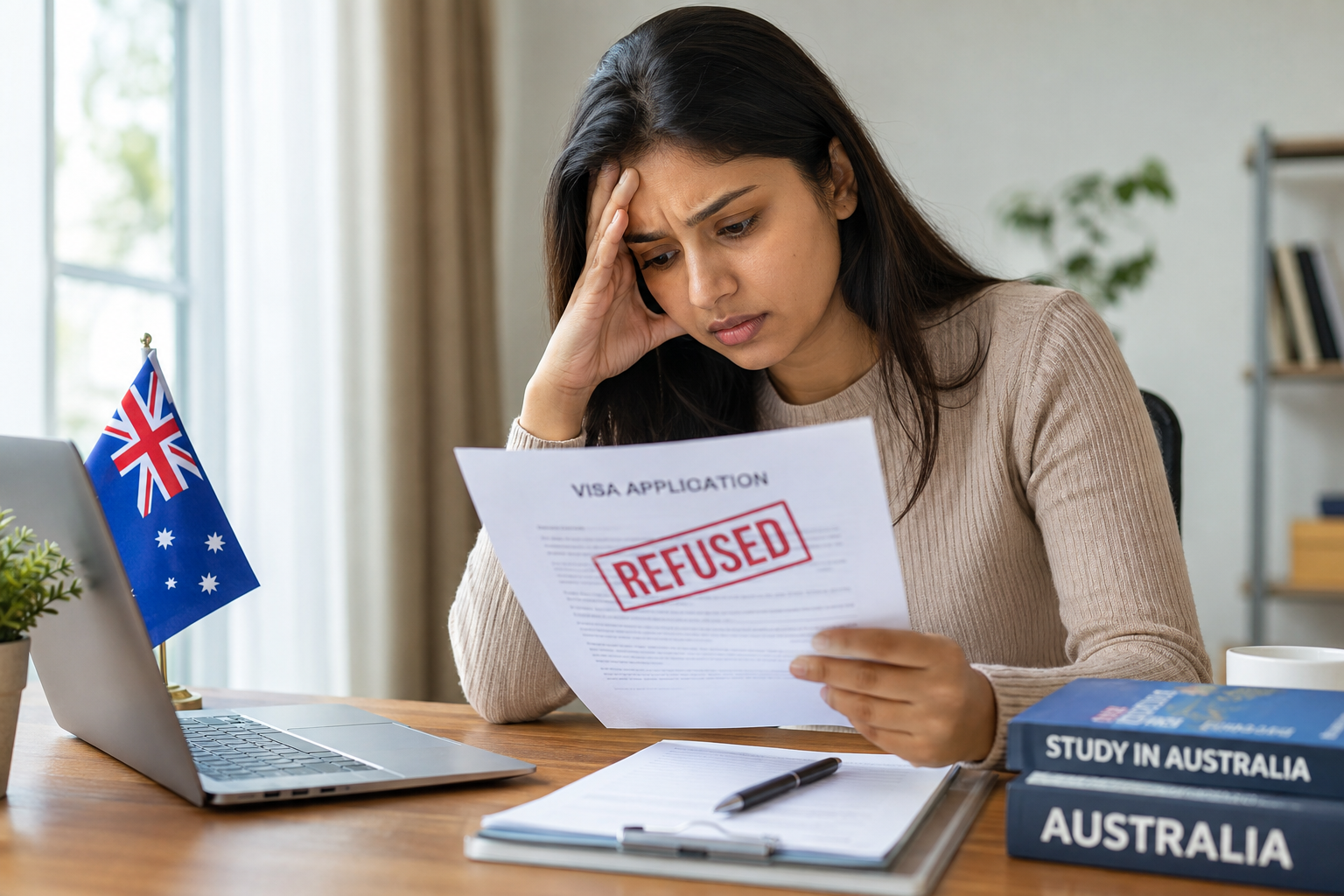
Australia continues to attract thousands of international students who want to study at respected universities, colleges and vocational institutions. However, getting an Australian Student Visa is not simply about receiving an offer letter from an education provider. In 2026, applicants are expected to demonstrate that they are genuine students, financially prepared, academically suitable and able to explain why their chosen course makes sense for their future.
For students planning to study in Australia, understanding the reasons behind Australia student visa refusals in 2026 is more important than ever. A strong application is not necessarily the one with the largest number of documents. It is the one where the student’s education history, course choice, financial position and future plans tell a clear and credible story.
The Australian Department of Home Affairs continues to assess Student Visa applications under the Genuine Student (GS) requirement, which replaced the former Genuine Temporary Entrant requirement for applications lodged from 23 March 2024.
So, what has changed in 2026, and what can students do to reduce the risk of refusal?
What Has Changed for Australia Student Visas in 2026?
The Australian student visa system has become more focused on application quality, student genuineness, financial preparedness and the integrity of international education.
One important development is the continued operation of Ministerial Direction 115, which applies to offshore Student Visa applications lodged from 14 November 2025. It introduced three processing priority levels for offshore applications and supports the Australian Government’s approach to managing international student growth across education providers.
It is important to understand that processing priority is not the same as visa approval. The Department of Home Affairs specifically states that a Ministerial Direction does not set the criteria for granting or refusing a Student Visa.
Another change relevant to 2026 applicants is the increase in the Student Visa application charge from 1 July 2026. Students should therefore check the current visa fee before submitting their application rather than relying on older information available online.
These developments make careful preparation increasingly important.
Why Are Australia Student Visas Refused in 2026?
There is no single reason behind every refusal. Each application is assessed according to the applicant’s individual circumstances and the evidence provided.
However, several areas deserve particular attention.
1. Weak Genuine Student Explanation
The Genuine Student requirement is one of the most important parts of an Australian Student Visa application.
Applicants need to demonstrate that studying in Australia is genuinely their primary reason for applying for the Student Visa. The Department considers factors such as previous studies, employment, family and community ties, financial circumstances, immigration history, the proposed course and the benefits of completing that course.
A generic statement such as:
“I want to study in Australia because it provides high-quality education and better career opportunities.”
may not explain enough.
A stronger application connects the student’s past education and experience with the proposed course.
For example, a student with a bachelor’s degree in information technology who chooses a relevant master’s program should be able to explain what additional knowledge the new course will provide and how it fits into their career plans.
The key is logic and evidence, not impressive wording.
2. Choosing a Course That Does Not Match the Student’s Background
Course selection can influence how an application is assessed.
If a student has an established academic or professional background but suddenly chooses a course with little apparent connection to their previous studies or career, the applicant should be prepared to explain the decision.
This does not mean students cannot change fields.
A career change can be genuine, but it should have a reasonable explanation supported by the student’s circumstances.
Students should be able to answer questions such as:
- Why this course?
- Why Australia?
- Why this particular education provider?
- Why study this course now?
- How will the qualification help with future employment?
- Why is studying this course in the student’s home country not the preferred option?
The Department specifically considers the applicant’s understanding of the proposed course, education provider and living arrangements in Australia.
3. Insufficient or Unclear Financial Evidence
Financial capacity remains another important part of the Student Visa process.
Students may need to demonstrate that they have access to sufficient funds for tuition, living expenses, travel and applicable expenses for accompanying family members.
The minimum financial capacity amount for a primary applicant was increased from AUD 24,505 to AUD 29,710 in 2024. Applicants should always check the latest requirements applicable to their situation before lodging an application because financial requirements can change.
Having money in a bank account is not necessarily the whole story.
The Department may also consider whether the applicant genuinely has access to the funds and, where another person is providing financial support, evidence of the relationship and the sponsor’s financial circumstances may be relevant.
Students should therefore avoid unexplained large deposits or financial documents that cannot be properly supported.
A transparent financial history is much easier to understand than a bank balance that appears suddenly without an explanation.
4. Inconsistent Information Across Documents
One of the most avoidable problems is inconsistency.
Imagine that:
- The application states that the student’s father is funding the education.
- The financial documents show another person providing the funds.
- The GS responses mention a different source of income.
- The student’s education documents show a different academic timeline.
Even if each document looks genuine individually, inconsistencies can create questions about the overall application.
Before submitting, students should carefully compare their:
- Passport details
- Academic records
- Employment history
- Financial documents
- Course information
- Personal statements
- Previous visa information
- Family details
Every important fact should be consistent and explainable.
5. Ignoring Previous Study or Employment Gaps
Study gaps are not automatically a reason for refusal.
However, unexplained gaps can become a concern when they are relevant to the applicant’s overall circumstances.
The Department encourages applicants to provide information about previous study, employment and relevant circumstances. For students who have studied in Australia previously, the Department may consider their study history, course changes, progress and gaps of more than two months during an academic year.
If you have a study gap, do not try to hide it.
Instead, explain what you were doing during that period and provide supporting evidence where appropriate.
For example, the gap may relate to:
- Employment
- Family responsibilities
- Professional training
- Health-related circumstances
- Preparation for further study
- Business activities
A genuine explanation supported by documents is generally more useful than leaving the period unexplained.
6. Incomplete Student Visa Documentation
A Student Visa application must include the required evidence.
For example, applicants must provide appropriate evidence of enrolment, including a valid Confirmation of Enrolment (CoE) for the intended course. Without the required CoE, an application may not be valid for processing.
The Department also provides a Document Checklist Tool to help applicants understand what evidence may be required according to their passport country and education provider.
Importantly, the checklist can change, so students should check it close to the time of submission rather than relying on an old checklist downloaded months earlier. The Department states that the tool is routinely updated.
7. Overlooking English Language Requirements
Depending on the student’s circumstances and course, evidence of English language ability may be required.
Students should not assume that an English test requirement is the same for every applicant. There are specific exemptions and different circumstances that can apply.
The Department’s current Student Visa information should therefore be checked before lodging the application, particularly because approved English testing arrangements and requirements can change.
How Can Students Prepare for an Australia Student Visa in 2026?
Preparation should begin well before the visa application is submitted.
Step 1: Select the Right Course
Do not choose a course only because it appears popular.
Consider your previous education, work experience, interests and realistic career direction.
Your course should make sense when someone looks at your academic and professional history.
Step 2: Research the Education Provider
Students should understand why they have selected their particular institution.
Research:
- Course structure
- Subjects
- Duration
- Location
- Entry requirements
- Tuition fees
- Facilities
- Career relevance
- Accommodation and living arrangements
The Genuine Student assessment specifically considers the applicant’s knowledge of the proposed course and education provider.
Step 3: Prepare Strong GS Responses
The online Student Visa application includes questions addressing the Genuine Student criteria.
Each response has a maximum of 150 words and must be written in English. The Department also advises applicants to support their statements with evidence because statements supported by evidence are given greater weight in assessment.
This means students should focus on being:
Specific + Honest + Relevant + Evidence-based
Avoid copying a generic GS statement from the internet.
Your response should reflect your own education, employment, financial circumstances and career plans.
Step 4: Organise Your Finances Early
Start preparing financial evidence before the visa application is ready.
Keep records relating to:
- Bank accounts
- Education loans
- Income
- Tax documents
- Sponsor income
- Employment
- Business income
- Major financial transactions
If a large transaction appears in your account, be prepared to explain its legitimate source.
Step 5: Review Your Complete Application Before Submission
Do not treat the application as a collection of separate documents.
Review it as one complete story.
Ask yourself:
Does everything make sense when viewed together?
Your course should make sense with your education.
Your education should make sense with your career plans.
Your financial evidence should make sense with your sponsor’s circumstances.
Your GS responses should match the evidence.
Your personal information should be consistent across all documents.
This final review can identify problems before the application reaches the decision-making stage.
Does Processing Priority Affect Visa Refusal?
This is an important distinction for students in 2026.
Under Ministerial Direction 115, offshore Student Visa applications can fall into different processing priority categories depending on the circumstances, including the education provider and type of study.
However, processing priority does not mean approval priority.
A higher processing priority does not guarantee that a visa will be granted, while a lower processing priority does not automatically mean that a visa will be refused.
The Department explicitly states that the Ministerial Direction determines processing priority rather than the criteria for granting or refusing the visa.
Students should therefore focus on application quality instead of trying to find a way around processing priorities.
What Should Students Do After an Australia Student Visa Refusal?
Receiving a refusal can be disappointing, but submitting another application immediately without understanding the previous decision can create additional problems.
First, carefully read the refusal notification.
Identify:
- The specific visa criteria discussed
- Concerns raised by the decision maker
- Missing or insufficient evidence
- Issues concerning Genuine Student requirements
- Financial concerns
- Previous visa or immigration history issues
Then assess whether the underlying issue can actually be addressed.
A new application should not simply repeat the same information.
If you are considering another application after a refusal, obtaining professional advice can help you understand your options and determine what evidence may be required.
Final Thoughts
Australia remains an attractive destination for international education, but students should approach the Australia Student Visa process in 2026 with realistic expectations.
The biggest lesson is simple: a successful application needs to tell a consistent and credible story.
Your course choice, academic background, financial circumstances, career plans and Genuine Student responses should support each other.
Do not rely on generic statements, unexplained financial transactions or outdated visa information. Check the current Department of Home Affairs requirements, prepare your evidence carefully and make sure your application reflects your actual circumstances.
For students planning to study in Australia, professional guidance can also help with course selection, documentation, Genuine Student preparation and the overall visa application process.
If you are planning to apply for an Australian Student Visa in 2026 and want to understand your application requirements before submission, Pyramid Consultants can help you assess your study and visa preparation needs.
Important: Australian visa requirements, fees, processing priorities and document requirements can change. Students should verify the latest requirements with the Australian Department of Home Affairs before lodging an application.