
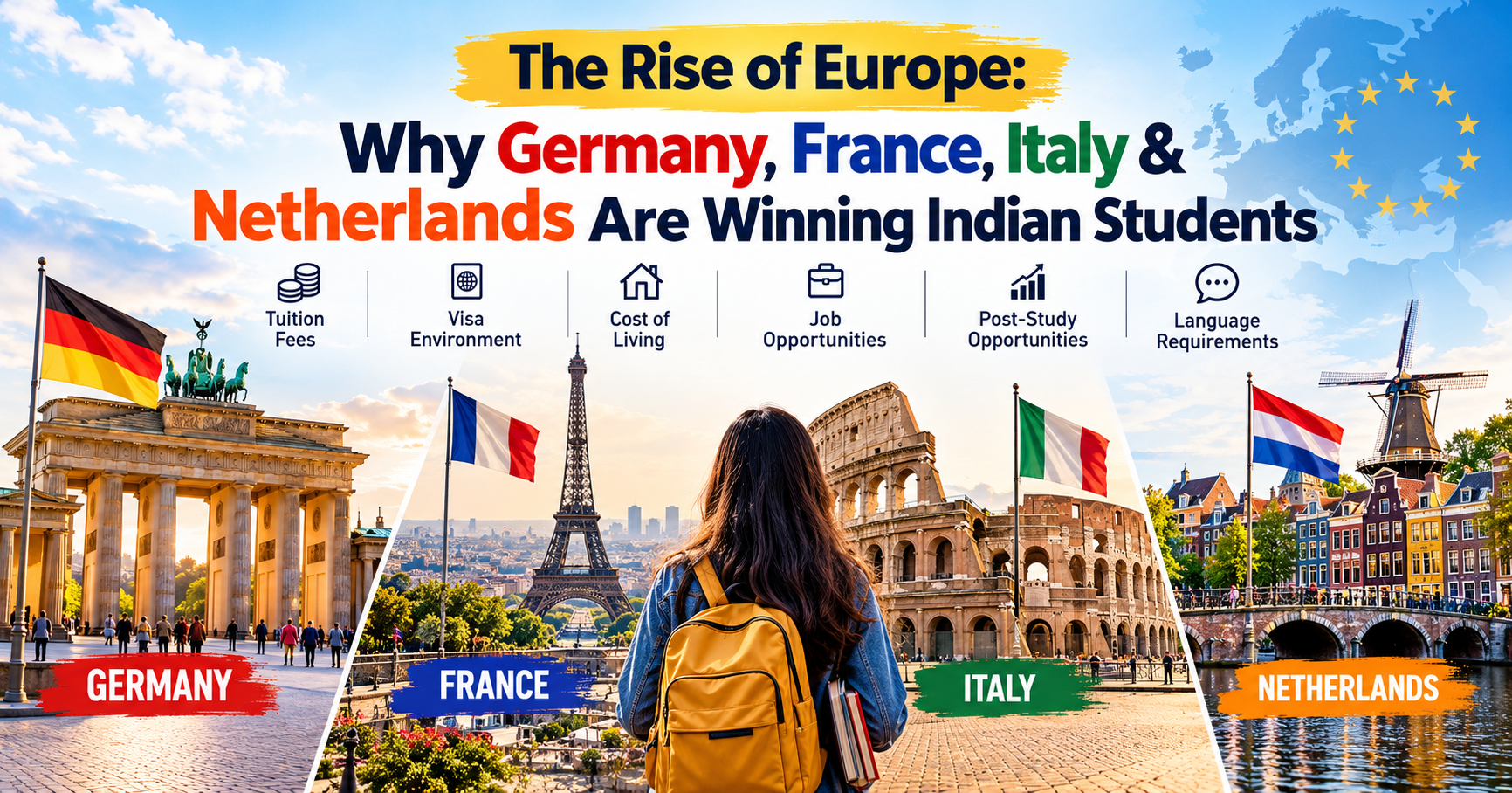
For Indian students planning to study abroad, Europe has become much more than an alternative to traditional destinations such as the USA, UK, Canada and Australia. In recent years, countries such as Germany, France, Italy and the Netherlands have attracted increasing attention from students looking for quality education, international exposure, career opportunities and a potentially more manageable overall study budget.
One of the biggest reasons behind Europe’s growing popularity is its diversity. Students can choose from technical and engineering programmes in Germany, business and management courses in France, affordable university options in Italy, or highly international and English-taught programmes in the Netherlands.
But which country is actually right for an Indian student?
The answer depends on several factors, including tuition fees, visa requirements, cost of living, job opportunities, post-study options and language requirements.
Let’s compare these four European destinations to understand why they are becoming increasingly popular among Indian students.
Why Are Indian Students Looking Towards Europe?
The international education landscape is changing. Students are becoming more conscious of the total cost of education rather than looking only at university rankings.
Europe offers several advantages:
- A wide range of internationally recognised universities
- Numerous English-taught programmes
- Strong industries and employment markets
- Opportunities to experience multiple European countries
- Different tuition-fee structures depending on the country and institution
- Growing demand for skilled international graduates
- Opportunities to build international work experience
Another advantage is the variety available within Europe. A student with a limited budget may find Italy particularly attractive, while an engineering graduate may prefer Germany. A student interested in luxury management or business may consider France, whereas someone looking for an English-speaking academic environment within continental Europe may look at the Netherlands.
Germany: A Top Choice for Engineering and Technical Education
Germany has established itself as one of Europe’s strongest destinations for international students, particularly those interested in engineering, technology, computer science, automotive studies, data science and other STEM fields.
Tuition Fees in Germany
One of Germany’s biggest attractions is its relatively low tuition-fee structure at many public universities. However, students should not assume that every German university or programme is completely free.
Public universities may charge little or no tuition for certain programmes, but students generally need to pay semester contributions. Some states and institutions may also have additional tuition requirements for certain categories of students or programmes.
Private universities can be considerably more expensive.
Visa Environment
Indian students generally need to demonstrate admission to an eligible institution and sufficient financial resources for their stay. Proof of financial support is an important part of the German student visa process.
Students should prepare their documentation carefully because financial proof, academic documents, health insurance and other requirements need to meet the applicable rules at the time of application.
Cost of Living
Germany can offer good value compared with several other Western destinations, but the cost varies considerably by city.
Munich, Frankfurt and other major cities can be expensive, while smaller university towns may be comparatively affordable.
Students should budget for:
- Accommodation
- Food
- Health insurance
- Transportation
- Study materials
- Personal expenses
Job Opportunities
Germany’s strong industrial base makes it attractive for graduates in engineering, IT, manufacturing, automotive technology, renewable energy and other technical areas.
Knowledge of German can significantly improve employment prospects, especially for jobs involving local customers or German-speaking teams.
Post-Study Opportunities
Germany provides pathways for international graduates to remain in the country and look for suitable employment after completing their studies, subject to the immigration rules applicable at the time.
For students who want to build a long-term European career, this can be an important advantage.
Language Requirements
Many master’s programmes are available in English. However, English-taught education does not necessarily mean that German is unnecessary.
Learning German can help students with:
- Part-time jobs
- Internships
- Daily communication
- Networking
- Local employment
Best suited for: Engineering, IT, computer science, automotive, technology and STEM students.
France: More Than Fashion and Business
France is another European destination gaining popularity among Indian students. The country combines internationally recognised education with strong industries in areas such as business, management, hospitality, engineering, technology, fashion and luxury management.
Tuition Fees in France
Tuition fees vary depending on the institution, programme and student’s status. Public institutions can be considerably more affordable than private business schools and specialised institutions.
Students should therefore compare the complete programme cost rather than assuming that all French universities have the same fee structure.
Visa Environment
International students generally need the appropriate student visa and must provide documents related to their admission, finances and accommodation, among other requirements.
Students from India should carefully follow the current application procedure and documentation requirements before submitting their visa application.
Cost of Living
Paris is one of Europe’s more expensive student cities. However, France has many other cities where the cost of accommodation and daily living can be more manageable.
Students considering France should compare the cost of living in their chosen city before finalising a university.
Job Opportunities
France has major industries in:
- Business and finance
- Luxury and fashion
- Hospitality and tourism
- Engineering
- Aerospace
- Technology
- Automotive
- Food and consumer goods
For students interested in international business, luxury management, hospitality or engineering, France can provide strong career exposure.
Post-Study Opportunities
International graduates may have options to remain in France for further professional opportunities, depending on their qualification, employment status and the immigration rules in force.
Students planning a long-term career should consider employment prospects and visa conditions together rather than looking only at the post-study period.
Language Requirements
A growing number of programmes are taught entirely in English, especially at the master’s level.
However, French remains extremely valuable.
Even basic French can make everyday life easier and can improve employability in positions where communication with French customers or colleagues is required.
Best suited for: Business, management, luxury, hospitality, fashion, engineering and technology students.
Italy: Affordable Education with a Rich Student Experience
Italy is increasingly attracting Indian students because of its combination of relatively accessible tuition, scholarships, internationally recognised universities and cultural experience.
It is particularly interesting for students who want to control their overall education expenses.
Tuition Fees in Italy
Italian universities have different fee structures depending on the institution, programme and student circumstances.
Public universities can be comparatively affordable, and eligible international students may also explore regional scholarships and other financial support schemes.
This is one of the major reasons Italy is increasingly appearing on the shortlist of Indian students.
Visa Environment
Students need the appropriate Italian study visa and must meet the relevant admission, financial and documentation requirements.
The exact process can change, so applicants should always check the latest official requirements before applying.
Cost of Living
The cost of living depends heavily on the city.
Milan and other major cities can be relatively expensive, while smaller cities may provide a more affordable student lifestyle.
Accommodation is generally one of the biggest expenses students need to consider.
Job Opportunities
Italy has opportunities across industries such as:
- Engineering
- Manufacturing
- Fashion
- Architecture
- Automotive
- Tourism
- Design
- Business
Students with technical and specialised skills can explore opportunities in Italy’s industrial sector.
Post-Study Opportunities
International graduates may have opportunities to transition into employment after completing their studies, depending on their qualification and applicable immigration regulations.
Students should understand the conditions attached to their residence status before making long-term plans.
Language Requirements
Several Italian universities offer English-taught programmes, particularly at the master’s level.
However, Italian can be extremely useful for part-time employment and everyday communication.
Students who invest time in learning Italian can potentially improve their integration and employment opportunities.
Best suited for: Engineering, architecture, fashion, design, business, tourism and students seeking relatively affordable European education.
Netherlands: An International and English-Friendly Study Destination
The Netherlands has become particularly attractive to students who want an internationally oriented academic environment with a large selection of English-taught programmes.
Dutch universities and higher education institutions offer programmes across areas such as business, engineering, technology, data science, logistics, economics and sustainability.
Tuition Fees in the Netherlands
Tuition fees for international students vary depending on the institution and programme.
For non-EU students, tuition can be significantly higher than the statutory fees applicable to eligible EU/EEA students.
Therefore, Indian students should carefully calculate tuition together with accommodation and living expenses.
Visa Environment
The Netherlands has a structured immigration system for international students. In many cases, the educational institution plays an important role in the residence-permit process.
Students should ensure that their admission and financial documentation meet the applicable requirements.
Cost of Living
The Netherlands can be relatively expensive, particularly in cities such as Amsterdam.
Accommodation is one of the most important considerations because housing availability can also be challenging in popular student cities.
Students should arrange accommodation as early as possible.
Job Opportunities
The Netherlands has a strong economy with opportunities in:
- Technology
- Engineering
- Logistics
- Finance
- Business
- Data science
- Renewable energy
- International trade
Its location also provides access to a highly connected European business environment.
Post-Study Opportunities
The Netherlands offers a post-study orientation period for eligible international graduates, allowing them to explore employment opportunities after completing their education.
This can make the country particularly attractive for students who want to gain international professional experience.
Language Requirements
The Netherlands stands out because many higher education programmes are available in English.
This can make the transition easier for Indian students who are not familiar with a European language.
However, learning Dutch can still be beneficial for students planning to build a long-term career and integrate into local society.
Best suited for: Technology, engineering, business, logistics, data science, sustainability and students seeking English-taught programmes.
Germany vs France vs Italy vs Netherlands: Quick Comparison
| Factor | Germany | France | Italy | Netherlands |
|---|---|---|---|---|
| Tuition | Low at many public universities; varies by state/programme | Varies; public institutions can be comparatively affordable | Often attractive; scholarships may help eligible students | Generally higher for non-EU students |
| Cost of Living | Moderate to high depending on city | Moderate to high; Paris is expensive | Moderate; major cities cost more | Generally high |
| Visa Environment | Financial proof is important | Structured student visa process | Admission and financial requirements apply | Institution-led immigration process in many cases |
| Job Market | Strong in engineering, IT & manufacturing | Strong in business, luxury, engineering & hospitality | Opportunities in engineering, design, fashion & tourism | Strong in technology, logistics & business |
| Post-Study | Employment pathways available under applicable rules | Professional pathways available under applicable rules | Employment pathways depend on status and regulations | Orientation-year option for eligible graduates |
| Language | German highly useful | French highly useful | Italian highly useful | English widely used; Dutch beneficial |
| Ideal For | STEM & engineering | Business, luxury & management | Affordable study, design & engineering | Technology & international business |
Which European Country Should Indian Students Choose?
There is no single “best” European country for every student.
The right destination depends on your academic background, budget, career goals, preferred course, language comfort and long-term plans.
Choose Germany if you want:
- Engineering or technical education
- Strong industrial exposure
- Technology and STEM career opportunities
- Potentially lower tuition at eligible public institutions
Choose France if you want:
- Business or management education
- Luxury and fashion
- Hospitality
- Engineering and technology
- An internationally recognised European degree
Choose Italy if you want:
- Potentially affordable education
- Scholarship opportunities
- Design, architecture or fashion
- Engineering and business programmes
- A culturally rich European experience
Choose the Netherlands if you want:
- English-taught programmes
- Technology and business education
- International exposure
- Strong logistics and technology industries
- Opportunities to gain professional experience after graduation
Final Thoughts
Europe’s growing popularity among Indian students is not simply a trend. It reflects a broader shift in how students evaluate international education.
Instead of considering only the most traditional destinations, students are increasingly comparing tuition fees, living expenses, visa requirements, employability, language requirements and post-study opportunities before making a decision.
Germany, France, Italy and the Netherlands each offer a different proposition.
Germany can be particularly attractive for STEM and engineering students. France stands out for business, luxury, hospitality and engineering. Italy can appeal to students looking for affordable education, scholarships and strong programmes in design, architecture and engineering. The Netherlands offers an international academic environment with a wide range of English-taught programmes and strong technology and business opportunities.
However, immigration rules, tuition fees, scholarship conditions and post-study policies can change. Students should always verify the latest official requirements before making an application.
If you are unsure which European destination matches your academic profile, budget and career plans, professional guidance can make the decision much easier.
Pyramid Overseas Education Consultants can help Indian students explore suitable European study destinations, universities, courses, admission requirements and the application process based on their individual goals.
Your journey to Europe should begin with the right destination—not simply the most popular one.