
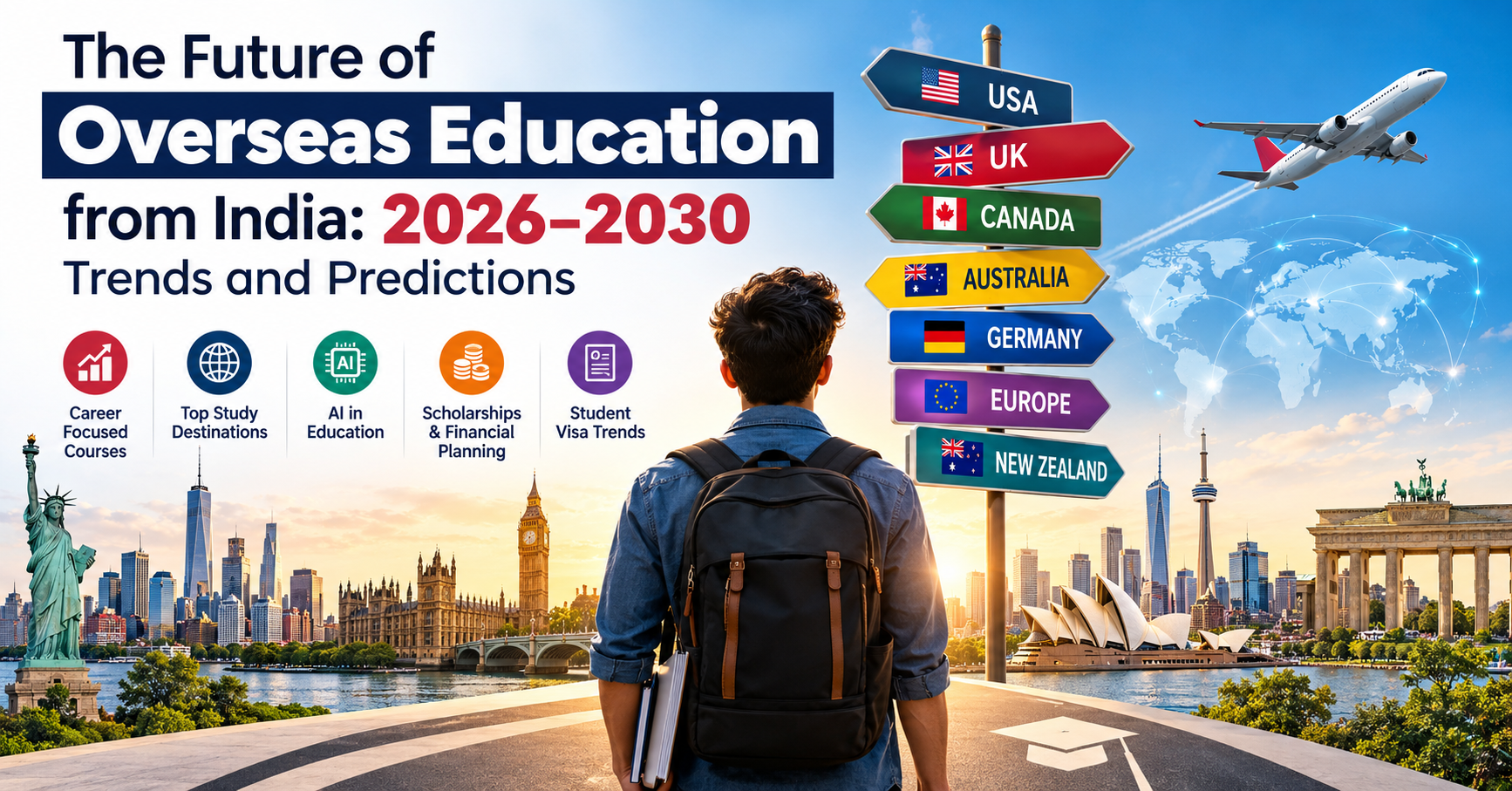
The dream of studying abroad continues to attract thousands of Indian students every year. From pursuing technology and business degrees to exploring healthcare, engineering, and emerging fields, international education offers opportunities to gain global exposure, develop practical skills, and build an international professional network.
However, the overseas education landscape is changing. Rising tuition fees, evolving immigration policies, advances in artificial intelligence, and changing employer expectations are influencing how students choose universities and destinations. What worked for students five years ago may not necessarily be the best approach for someone planning to study abroad in 2027 or 2030.
Between 2026 and 2030, overseas education from India is expected to become more career-focused, technology-driven, and financially planned. Students will increasingly evaluate universities based on employability, course relevance, total study costs, and post-study opportunities rather than relying solely on a country’s popularity.
For Indian students planning their international education journey, understanding these emerging trends can help them make more informed decisions.
1. Career-Oriented Courses Will Become More Popular
One of the biggest trends shaping the future of overseas education is the growing demand for courses that connect academic learning with real-world employment.
Students are becoming more conscious of the relationship between their qualifications, practical skills, and long-term career goals. Instead of selecting a course simply because it is popular, many applicants will look for programmes that offer industry projects, internships, practical training, and opportunities to work with modern technologies.
Fields likely to attract continued interest include:
- Artificial intelligence and machine learning
- Data science and business analytics
- Cybersecurity and cloud computing
- Healthcare and nursing
- Engineering and renewable energy
- Supply chain management and logistics
- Finance, fintech, and business management
- Environmental science and sustainability
These fields are not guaranteed routes to employment. Career outcomes depend on the chosen qualification, the local labour market, work authorisation, and an individual’s skills.
Prediction for 2026–2030: Indian students will increasingly compare overseas courses according to their curriculum, industry connections, practical experience, and graduate employment outcomes.
2. Students Will Explore More Study Destinations
For many years, the USA, UK, Canada, and Australia have remained prominent choices for Indian students. These countries continue to offer internationally recognised institutions and a wide variety of academic programmes.
However, students are also exploring a broader range of destinations as they compare tuition fees, living expenses, course availability, language requirements, and immigration regulations.
Germany, France, Ireland, the Netherlands, Spain, and other European destinations may appeal to students looking for specialised programmes, international exposure, or different cost structures. New Zealand and selected Asian destinations may also suit students seeking particular academic or professional pathways.
The best country depends on individual priorities. For example, a student interested in engineering may prioritise technical universities and research opportunities, while someone pursuing business analytics may focus on industry connections and internship availability.
Before choosing a destination, Indian students should compare:
- Total tuition fees and estimated living expenses
- Availability of relevant courses in English
- University accreditation and academic reputation
- Scholarship opportunities and eligibility requirements
- Student visa requirements and financial documentation
- Current post-study work rules and employment conditions
Prediction for 2026–2030: Destination selection will become more personalised, with students comparing several countries instead of automatically choosing the most familiar option.
3. Artificial Intelligence Will Transform International Education
Artificial intelligence is changing how students learn, research, and prepare for professional careers. Universities are incorporating AI-related subjects into various programmes, while employers increasingly value digital literacy and the ability to use emerging technologies responsibly.
Students planning to study abroad may encounter AI applications in fields beyond computer science, including marketing, finance, healthcare, manufacturing, education, and supply chain management.
For example, a business student may learn how AI supports market research and forecasting, while an engineering student may explore automation and intelligent manufacturing systems.
AI will also influence the application journey. Students may use digital tools to compare courses, organise application documents, practise interviews, and improve their understanding of admission requirements. However, applicants must verify information through official university and government websites.
Students should also follow university rules concerning AI-assisted assignments, plagiarism, academic integrity, and disclosure of AI-generated work.
Prediction for 2026–2030: Digital skills and responsible AI use will become increasingly valuable across academic disciplines. Students who combine subject knowledge with critical thinking and practical technology skills may be better prepared for changing workplace expectations.
4. The Return on Investment Will Influence Country Selection
Studying abroad can be a significant financial commitment for Indian families. Tuition fees, accommodation, food, insurance, travel, and other expenses can add up quickly.
Consequently, return on investment (ROI) will become an increasingly important consideration when selecting an international university.
However, ROI should not be measured only by the possibility of earning a high salary after graduation. Students should also consider the quality of education, career development, professional networks, international exposure, and the total cost of completing their degree.
A practical financial assessment should include:
- Tuition fees for the entire programme.
- Accommodation and daily living expenses.
- Health insurance, travel, and administrative costs.
- Available scholarships and confirmed funding.
- Potential changes in exchange rates.
- Employment opportunities relevant to the qualification.
- Current work authorisation rules and realistic career scenarios.
Students should avoid assuming that part-time employment will cover all their expenses or that they will automatically secure a job after graduation.
Prediction for 2026–2030: Families will increasingly compare the total cost of education against realistic career outcomes, making financial planning a central part of overseas education counselling.
5. Immigration Policies Will Play a Bigger Role in Decision-Making
Student visa policies and post-study work regulations are important factors in international education planning. Governments periodically revise eligibility criteria, financial requirements, dependent rules, work permissions, and graduate employment pathways.
As a result, Indian students must understand the difference between receiving admission to a university, obtaining a student visa, securing permission to work after graduation, and qualifying for permanent residency.
These are separate processes, and success in one does not guarantee success in another.
For students planning to study abroad from 2026 to 2030, relying on outdated social media posts or advice from friends can lead to poor decisions. Visa rules should always be checked through the relevant country’s official immigration department and the university’s international student office.
Students should pay particular attention to:
- Student visa eligibility and financial evidence
- English-language requirements
- Permitted working hours during studies
- Post-study work eligibility and duration
- Rules relating to dependants, where applicable
- Any relevant occupation, salary, or sponsorship requirements
Prediction for 2026–2030: Immigration awareness will become an essential part of choosing a study destination. Students will benefit from evaluating the current rules and potential risks before committing to a programme.
6. Scholarships and Financial Planning Will Gain Importance
With international education costs varying considerably across countries and universities, scholarships and other legitimate funding options will remain important for Indian applicants.
Universities may offer merit-based awards, need-based assistance, departmental scholarships, research funding, or country-specific opportunities. Eligibility can depend on academic performance, programme selection, financial circumstances, nationality, and application deadlines.
Students should research scholarships early rather than waiting until they receive an admission offer.
A strong financial plan should include confirmed funding sources, realistic living expenses, emergency savings, and a clear understanding of any education loan obligations.
It is also important to distinguish between a scholarship that reduces tuition fees and a funding arrangement that covers living expenses. Some awards cover only a portion of the total cost.
Prediction for 2026–2030: Students who begin financial planning early and compare funding opportunities across institutions may have more flexibility when choosing a suitable university.
7. Practical Learning and Industry Experience Will Matter More
A degree provides academic knowledge, but employers also look for communication skills, problem-solving abilities, teamwork, and practical experience.
This is why internships, industry-linked projects, research opportunities, laboratory work, and professional placements can be important when comparing universities.
For example, a student pursuing supply chain management may benefit from exposure to logistics systems and data analysis. A healthcare student may need structured clinical training that meets the relevant professional requirements. A computer science student may value opportunities to contribute to practical software projects.
Students should examine the actual curriculum instead of relying only on a programme’s title or promotional material.
Useful questions to ask include:
- Does the course include practical projects?
- Are internships available, and are they guaranteed or competitive?
- Does the programme have relevant industry partnerships?
- What career support does the university provide?
- Are graduates eligible for the professional recognition required in their chosen field?
Prediction for 2026–2030: Course selection will increasingly focus on the complete learning experience, including the practical skills students can develop alongside their academic qualifications.
8. Flexible Learning and Specialised Qualifications Will Expand
Traditional full-time degrees will remain important, but international education offers a wider range of learning formats, including postgraduate certificates, specialised master’s programmes, research degrees, and selected online or blended courses.
These options may appeal to students who want to develop expertise in a particular area or build on existing professional experience.
However, flexibility does not mean every programme is suitable for every student. Applicants must confirm whether the qualification meets their academic objectives, employer expectations, professional licensing requirements, and any applicable visa conditions.
Students considering an online or blended programme should also verify whether its delivery format qualifies for the immigration or post-study work benefits they expect. Not every qualification or mode of study provides the same eligibility.
Prediction for 2026–2030: More students may compare specialised qualifications and flexible learning formats alongside traditional degrees, particularly when they want to develop specific professional skills.
9. Personalised Overseas Education Counselling Will Become More Valuable
As international education choices become more complex, students may find it difficult to evaluate every relevant factor independently.
A suitable study destination depends on more than academic marks or a preferred country. It also involves the student’s budget, previous qualifications, language proficiency, career ambitions, preferred learning environment, and eligibility for the selected programme.
Personalised overseas education counselling can help students organise these considerations and develop a realistic application strategy.
A well-planned counselling process may include:
- Assessing academic qualifications and eligibility
- Shortlisting suitable universities and programmes
- Comparing tuition fees and living costs
- Identifying relevant scholarship opportunities
- Understanding English-language test requirements
- Preparing admission applications and supporting documents
- Reviewing current student visa requirements
- Planning application timelines and pre-departure arrangements
Students should choose an education consultant who communicates transparently, explains relevant requirements, and encourages applicants to verify important information through official sources.
No consultant can guarantee university admission, visa approval, employment, or permanent residency.
Prediction for 2026–2030: Overseas education guidance will increasingly emphasise individual suitability, informed decision-making, and transparent planning rather than simply promoting a destination.
10. Early Planning Will Give Students a Stronger Starting Point
International university applications involve multiple stages, and some programmes have limited places or early application deadlines. Students who begin researching in advance can have more time to prepare for English-language tests, organise financial documents, compare courses, and meet admission requirements.
For students considering the 2027 intake and beyond, early planning can reduce avoidable delays and help them identify suitable alternatives.
A practical preparation timeline may look like this:
12–18 months before the intended intake: Research countries, universities, courses, eligibility criteria, and approximate costs.
9–12 months before intake: Prepare for required language tests, shortlist institutions, explore scholarships, and organise financial planning.
6–9 months before intake: Submit applications according to university deadlines and respond to requests for additional documentation.
3–6 months before intake: Review admission decisions, confirm funding, and prepare the student visa application according to the relevant official requirements.
After visa approval: Arrange accommodation, travel, insurance, and other pre-departure requirements.
This is a general planning guide, not a universal deadline schedule. Actual timelines vary by country, university, programme, intake, and visa processing requirements.
Prediction for 2026–2030: Students who start early and maintain realistic backup options may be better positioned to navigate changing admission and immigration requirements.
Conclusion: Preparing Indian Students for the Future of Global Education
The future of overseas education from India between 2026 and 2030 will be shaped by technology, career-focused learning, financial considerations, changing immigration policies, and a wider choice of study destinations.
For Indian students, the most effective approach will be to look beyond popular destinations and select a course that aligns with their academic background, career objectives, budget, and long-term plans.
A successful international education journey begins with informed research. Students should compare universities carefully, evaluate the complete cost of education, develop practical skills, and check official admission and visa requirements before making major commitments.
Planning to study abroad in 2027 or beyond? Pyramid Overseas Education Consultants can help you explore suitable study destinations, shortlist relevant courses, understand admission requirements, and plan your next steps towards international education.
Start preparing today to make a more informed decision about your global academic future.