
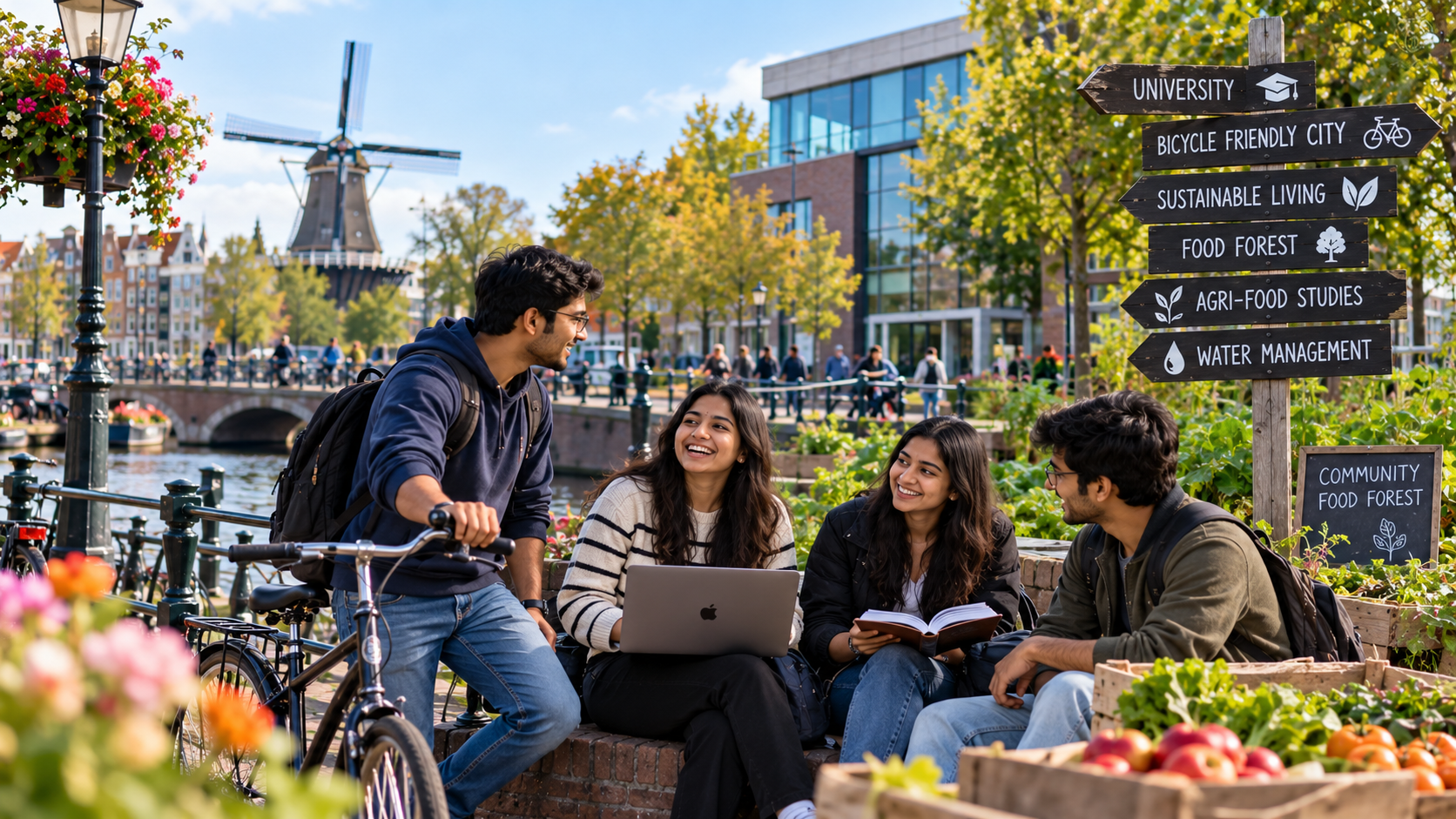
Imagine walking through a public food forest where fruit trees, edible plants and green spaces are part of the local landscape. Instead of buying every ingredient from a supermarket, you discover a community space that encourages people to reconnect with nature. A few minutes later, you are cycling to university, passing canals, sustainable buildings and neighbourhood markets.
For many Indian students, this is the Netherlands they do not fully imagine before studying abroad.
The Netherlands offers much more than internationally recognised universities and English-taught courses. Its cycling culture, sustainable living practices, innovative agriculture and world-class water management make it an interesting destination for students who want to learn in an internationally connected environment.
However, moving from India to the Netherlands also involves adjustments. The weather can be unpredictable, accommodation requires early planning, card payments are common, and everyday customs may differ from what Indian students are used to.
If you are planning to study in the Netherlands, understanding these differences before departure can help you prepare for a smoother transition.
1. Food Forests and Sustainable Living: A Different Way to Experience Nature
One of the interesting aspects of sustainable living in the Netherlands is the growing interest in community gardens, urban agriculture and food forests.
A food forest is a carefully designed growing environment that combines trees, shrubs, herbs and other edible plants. Inspired by natural ecosystems, these spaces aim to encourage biodiversity while producing food. Some community projects also create opportunities for residents to learn about growing plants, protecting wildlife and using land responsibly.
These spaces are not found everywhere, and access to fruit or other produce depends on the individual project’s rules. Nevertheless, they reflect a wider interest in making cities greener and encouraging more sustainable lifestyles.
For Indian students, this can be a refreshing experience. You may discover community gardens near residential areas, cycle past green public spaces or participate in sustainability activities organised by a university.
The idea is not simply to live in a greener country. It is to understand how environmental thinking can influence food production, urban planning and everyday decisions.
Students interested in environmental science, sustainable agriculture, ecology and food systems may find these themes particularly relevant to their academic interests.
2. Cycling Is Part of Everyday Life
If you are accustomed to travelling by scooter, car, auto-rickshaw or public transport in India, cycling may initially feel like a completely different way of getting around.
In the Netherlands, bicycles are an important part of daily transportation. Dedicated cycling routes, bicycle parking areas and relatively short distances between many residential neighbourhoods and educational institutions make cycling practical in numerous locations.
The Dutch government’s transport information describes cycling as a fully established alternative to cars and public transport for short journeys. However, how convenient cycling is will depend on your city, campus and accommodation.
For students, cycling can help reduce routine transport expenses and provide flexibility when travelling to classes, supermarkets or nearby social activities.
What should Indian students prepare for?
- Learn the cycling rules: Understand traffic signs, cycle-lane markings and right-of-way rules before riding independently.
- Choose a suitable bicycle: A second-hand bicycle may be economical, but check its condition, brakes, lights and locks.
- Prepare for wet weather: Waterproof clothing and suitable lights are useful for commuting in rain or low visibility.
- Secure your bicycle: Use a reliable lock and park in permitted areas.
- Practise before busy journeys: Cycling in a new country can be challenging until you become familiar with local traffic patterns.
You do not necessarily need to cycle everywhere. Trains, buses, trams and other public transport options can help you reach destinations that are farther away. The key is to choose a practical transport arrangement based on your daily routine.
3. Why the Netherlands Is Interesting for Agriculture and Food Technology Students
The Netherlands is an appealing destination for students who want to explore the relationship between agriculture, technology, food production and sustainability.
Agriculture is not limited to traditional farming. Modern agricultural education can involve controlled growing environments, crop science, resource efficiency, agricultural engineering, supply chains and digital technologies.
Food technology is another field worth exploring. Depending on the programme, students may learn about food safety, product development, nutrition, sustainable food processing and quality control.
These subjects are relevant to global challenges such as feeding growing populations, reducing food waste and making food production more efficient.
Courses worth researching
- Sustainable agriculture and agricultural sciences
- Food technology and food science
- Horticulture and plant sciences
- Environmental science and sustainability
- Agricultural business and supply chain management
- Biotechnology and related life sciences
The Netherlands offers programmes across different institutions, so compare the curriculum, entry requirements, teaching approach and practical learning opportunities rather than selecting a course based only on its name.
For example, the official Study in NL portal lists a Food Technology programme at Van Hall Larenstein University of Applied Sciences. Its programme description includes food safety, product development, nutrition and sustainable food processing.
This illustrates how students can explore specialised courses that connect scientific knowledge with practical applications.
For Indian students considering agriculture or food-related careers, it is worth investigating whether a programme aligns with their previous education and long-term career plans.
4. Water Management: Learning from a Country That Lives With Water
The Netherlands is also known for its experience in water management, flood protection and water-related engineering.
Because significant parts of the country are vulnerable to flooding and many areas depend on carefully managed water systems, water management is an important field of study and public planning.
Students may explore subjects such as water quality, flood-risk management, climate adaptation, river systems, coastal protection and sustainable urban development.
These topics have relevance well beyond Europe. India also faces challenges involving flooding, drought, groundwater depletion, water pollution and the effects of climate change.
Who should consider water management studies?
This field may suit students interested in:
- Civil and environmental engineering
- Hydrology and water resources
- Climate change and environmental policy
- Flood-risk assessment and disaster management
- Sustainable urban planning
- Water quality and ecosystem protection
The official Study in NL portal lists a Water Management bachelor’s programme at HZ University of Applied Sciences. The programme description highlights practical learning and real-world water challenges.
Before applying, check the programme’s academic prerequisites, whether mathematics or science subjects are required, and whether the degree matches your intended career direction.
It is also important to investigate internship arrangements, professional accreditation where relevant, and the language requirements of potential employers.
5. Everyday Payments May Work Differently From India
Indian students often use UPI for everyday purchases, from street food to shopping and splitting restaurant bills. In the Netherlands, you will encounter a different payment environment.
Card and contactless payments are widely used, while some shops and businesses may have restrictions on cash or particular card types. Payment acceptance varies by establishment.
You may also encounter Tikkie, a popular service used to request money from friends or split shared expenses. For example, a classmate might send a payment request after you share groceries or a meal.
How to prepare
- Check whether your Indian debit or credit card works internationally.
- Understand foreign transaction fees and currency conversion charges.
- Keep an alternative payment method for emergencies.
- Ask your bank about international usage limits before travelling.
- Investigate suitable local banking options after arrival.
Do not assume every shop accepts every international card. It is sensible to check payment options before making a purchase or relying on a particular method.
Public transport also uses convenient digital payment systems. Depending on the service and your circumstances, you may be able to use a supported contactless card, smartphone or transport payment option. Always check the current rules for your route.
A little preparation can prevent unnecessary stress during your first few days.
6. Tipping Culture: You Do Not Need to Follow Every Habit From India
Tipping practices in the Netherlands may differ from those in India.
In many everyday situations, tipping is not as strongly expected as it may be in some other countries. Restaurants and cafés may already include service costs in their pricing, and customers sometimes leave a small additional amount when they are satisfied with the service.
There is no need to feel pressured to tip a fixed percentage everywhere.
For instance, you might round up a bill or leave a modest tip after a particularly good dining experience. Whether you do so can depend on the establishment, the service and your budget.
As a student, focus first on understanding the displayed prices, checking the bill and managing your monthly expenses. Tipping is a personal decision rather than something that should create financial pressure.
It is also worth remembering that social habits can vary between cities and individual businesses. Observing local practices and asking politely when unsure is a sensible approach.
7. Cannabis Rules: Understand the Law Before You Arrive
The Netherlands is sometimes associated with its cannabis policy, but international students should not interpret this as meaning that cannabis is legal without restrictions.
Dutch policy tolerates certain limited cannabis-related activities under specific conditions. Possession, sale and production remain subject to legal restrictions, and coffee shops operate under rules that include age limits and restrictions on quantities.
Municipalities may apply additional requirements, and rules concerning access for non-residents can vary in their implementation. Students should not assume that every coffee shop will admit international visitors.
If you are moving to the Netherlands for education, the safest approach is to understand the applicable laws and avoid activities that could affect your health, studies, residence status or future opportunities.
You do not need to participate in any such activity to enjoy Dutch student life. Universities offer many other ways to meet people, including student associations, sports clubs, cultural events, volunteering and academic societies.
For accurate information, consult the official Dutch government guidance rather than relying on social media posts or advice from acquaintances.
8. Dutch Weather Can Be a Surprise for Indian Students
The weather is another adjustment that students from India should take seriously.
The Netherlands generally experiences a temperate maritime climate, with cool winters, relatively mild summers and changeable conditions throughout the year. Rain, wind and cloudy skies can affect everyday plans, including cycling and walking to university.
Students arriving from Gujarat or other warmer parts of India may need time to become comfortable with the colder months and shorter winter daylight hours.
What should you pack?
Consider bringing or purchasing:
- A waterproof jacket with a hood
- Comfortable, water-resistant footwear
- Warm layers for winter
- Gloves and a scarf for colder days
- An umbrella for suitable conditions
- Clothing that can be layered as temperatures change
You do not necessarily need to buy an entire winter wardrobe in India. Compare prices and consider purchasing some items after arrival, especially if you are unsure which clothing will be most practical.
Check the seasonal forecast before travelling, and remember that wind and rain can make conditions feel colder than the temperature alone suggests.
A flexible wardrobe and a willingness to adapt will make daily life easier.
9. Finding Accommodation Requires Early Planning
One of the most important preparations for international students is arranging accommodation.
The Netherlands faces a significant housing shortage, and finding an affordable room close to a university can be challenging. The Embassy of India in The Hague advises prospective students to arrange accommodation before arriving.
Start researching housing as soon as you receive an offer or begin planning your application. Check university accommodation services, legitimate rental platforms and other verified options.
Before paying a deposit, verify the landlord, rental agreement, address and payment details. Be cautious of unusually cheap listings, requests for urgent transfers and landlords who refuse reasonable verification.
Also calculate the full cost of living, including rent, food, transport, utilities, insurance where applicable, study materials and personal expenses.
A realistic budget is more useful than relying on a general estimate that may not reflect your city or lifestyle.
10. Build a Student Life That Goes Beyond the Classroom
Moving abroad is not only an academic decision. It is also an opportunity to develop independence, meet people from different backgrounds and experience a new culture.
Many Dutch institutions offer student associations, sports activities, international student networks and events that can help newcomers settle in.
English is widely used in many international academic environments, but learning basic Dutch phrases can still be valuable. It can make everyday interactions easier and demonstrate an interest in the local culture.
You should also prepare for differences in communication. Directness is common in Dutch professional and social settings, and people may express opinions more explicitly than you expect. This is not necessarily intended to be rude; it can reflect a different communication style.
Maintain contact with family and friends in India while making an effort to establish a routine in your new surroundings. Cooking familiar meals, joining student groups and exploring your neighbourhood can help you feel more settled.
Most importantly, give yourself time to adjust. It is normal for the first few weeks to involve practical challenges and moments of homesickness.
11. A Practical Checklist Before Moving to the Netherlands
Before departure, work through the following essentials:
- Confirm that your chosen institution and programme meet your academic and career goals.
- Check the official admission, tuition fee and immigration requirements.
- Arrange accommodation and verify your rental agreement.
- Prepare funds for tuition, housing and initial living expenses.
- Check your passport, visa or residence documentation and travel arrangements.
- Carry the documents required for registration and other formalities.
- Understand health insurance requirements for your student and employment circumstances.
- Check international card access and alternative payment methods.
- Pack suitable clothing for the season.
- Learn basic cycling safety and local travel rules.
- Research student support services and university orientation activities.
If you will live in the Netherlands for more than four months, municipal registration is generally required. Check the applicable process and documents with your municipality and the Dutch Immigration and Naturalisation Service (IND).
Planning these essentials in advance can help you focus more on your education and less on avoidable administrative problems after arrival.
Conclusion: Is the Netherlands a Good Choice for Indian Students?
The Netherlands can offer a distinctive combination of international education, practical learning, sustainable living and exposure to global industries.
From community food forests and cycling-friendly cities to specialised programmes in agriculture, food technology and water management, the country provides plenty of opportunities for students whose interests align with these fields.
At the same time, a successful study-abroad experience depends on realistic preparation. Housing can be difficult to secure, the weather may take adjustment, and payment systems, social customs and local regulations may differ from those in India.
The best approach is to research your university carefully, plan your finances, understand the local rules and arrive with an open mind.
Planning to study in the Netherlands? Pyramid Overseas Education Consultants can help you explore suitable courses, compare universities, understand admission requirements and prepare for the application process. Make an informed decision based on your academic background, budget and long-term goals before beginning your international education journey.